
Is laser cleaning safe? Dust, chemicals and the environmental case
Cleaning a surface at home should not create a second problem in your garden, your drains or your lungs. This is how laser cleaning compares with the traditional alternatives on the things that actually matter at a residential address: airborne dust, waste, chemicals and controlled working.
The dust problem with abrasive blasting
Abrasive blasting is the most familiar alternative, and its principal hazard is well documented. Blasting sand, mineral media and the substrate itself can release respirable crystalline silica, which the UK Health and Safety Executive controls at a workplace exposure limit of 0.1 mg/m³ averaged over eight hours. It is a recognised cause of silicosis and is classified as carcinogenic to humans by IARC. Sand blasting has been banned or heavily restricted in a number of European countries for exactly this reason.
At a home address there is a second, more mundane issue: containment. Blasting throws media and debris well beyond the work area. Grit ends up in lawns, gravel, gutters and drains, and on any car parked nearby.
The chemical route and its paperwork
Chemical paint strippers and rust converters work, but they bring solvent vapours, skin-contact risk and a hazardous liquid waste stream that cannot legally go down a domestic drain. Many traditional strippers were reformulated after dichloromethane was restricted for consumer and most professional use in the EU and UK, and the replacements typically need longer dwell times and more washing off — which means more contaminated runoff.
What laser cleaning removes from the equation
- No blasting media, so no grit to spread, sweep up or dispose of
- No solvents, acids or rust converters, so no liquid hazardous waste
- No water, so no runoff into drains or soakaways
- Debris is fine, dry particulate drawn into a filtered extraction unit at source
The waste that remains is a small quantity of captured dust — the vaporised oxide and coating — which is contained in the filter rather than distributed across your property.
The controls a laser job does require
Laser cleaning is not hazard-free; it simply has different hazards, and they are controllable and confined to the work zone.
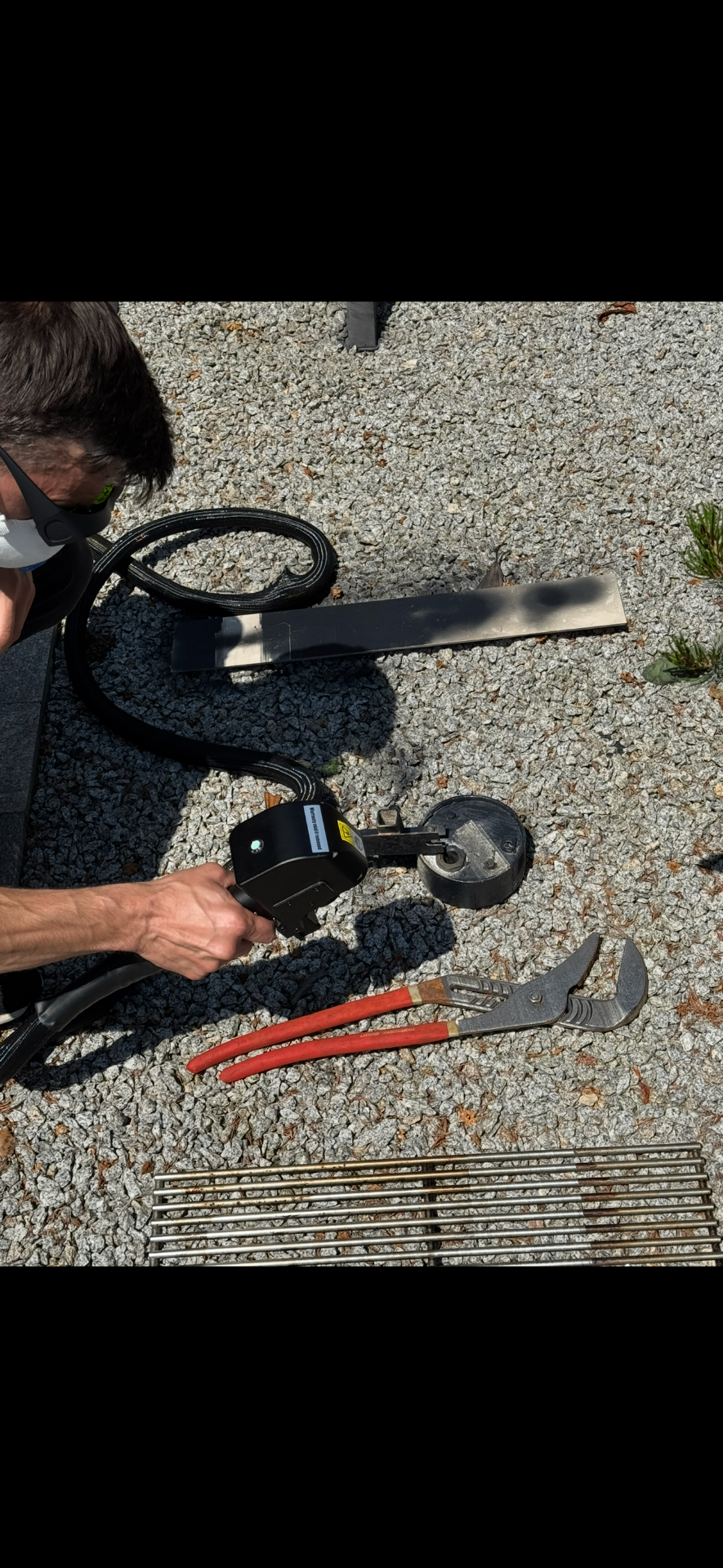
- Eye protection and a controlled zone. The 1064 nm beam is invisible and is an eye hazard. We set a marked exclusion zone and wear wavelength-rated eyewear; nobody outside that zone needs protection.
- Fume extraction. Ablated coatings — especially old paint, which on pre-1992 UK housing and older vehicles may contain lead — are captured at source and filtered rather than released.
- Reflective surroundings. Glass, chrome and polished stone near the work are masked or screened.
- Fire watch. Dry vegetation, fuel lines and combustible debris are cleared before work starts.
What this means for a residential visit
In practice, work happens inside a small, marked area. There is no sheeting over half the garden, no wash-down afterwards, and no waiting for a surface to dry. When we finish, the area is swept, the surface is dry and ready for coating, and the only thing leaving your property is the equipment and its filter.
Exposure limits quoted are from HSE guidance note EH40 and are provided for context. Every job is planned around the specific site, and we are happy to talk through the controls before we arrive.
Want a straight answer for your surface?
Send us a photo and a few details. We will tell you honestly whether laser cleaning is the right method, and what it would take.
Email admin@apex21.co.uk